AIHC × Digital Archaeology

Read the mark.
Question the meaning.

ShailDrishti is an evidence-led experiment for studying the rock art of Chhattisgarh—separating what a panel shows from what a researcher infers.

05
verified views
01
documented shelter
03
interpretive lenses
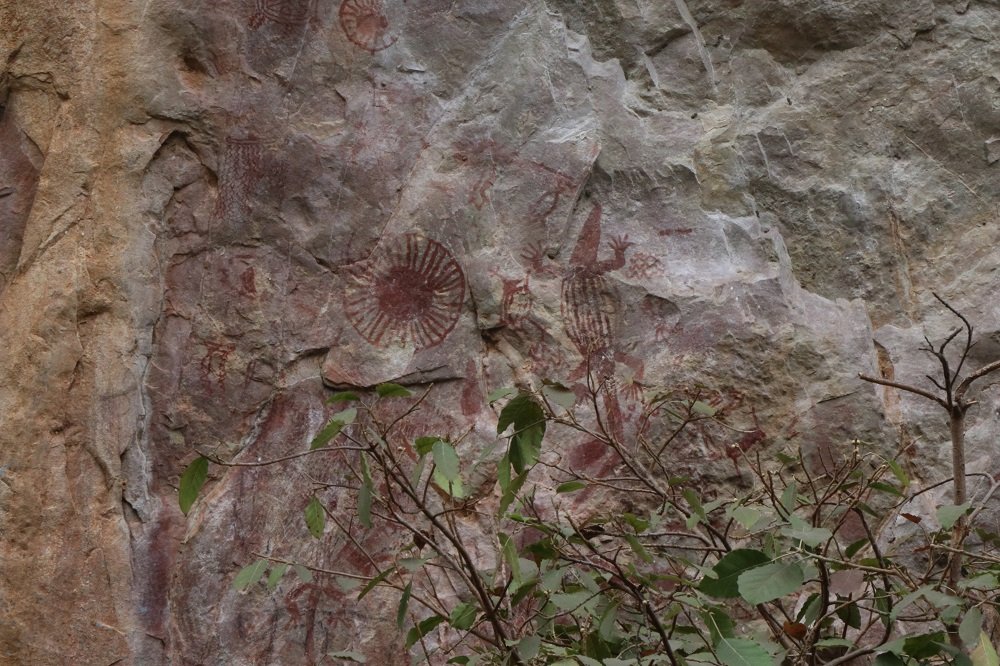
A documented rock-art panel at Kabra Pahar
01Kabra PaharRaigarh district, ChhattisgarhSource verified

00 — Premise

Not an AI that “decodes” the past.

An academic interface that makes uncertainty visible.

AI can help organise records and locate visual similarities. It cannot decide that a prehistoric image was sacred, identify its maker or replace archaeological and community knowledge.

01 — Evidence explorer

Five views. Three ways of reading.

Select a record, then move between observation, interpretation and safeguard. The published identification always remains visible.

Rock surface at Kabra Pahar with red radial, animal-like and complex linear motifs SD-KP-001 Photo: Rohit Rajak / Sahapedia

Composite panel

Radial forms and a crowded motif field

High for the radial form; low for ritual function
Published identification

Sahapedia identifies a wheel, monitor lizard, peacock, tortoise and complex line work in this view.

Observation

Two prominent red radial forms sit among filled and outlined figures. Superimposition, fading and the uneven stone surface make several smaller forms difficult to separate.

02 — Method

An evidence ladder for responsible interpretation.

Each upward step adds inference. Confidence should narrow—not grow—as a claim moves further from the visible surface.

  1. 01
    Visible mark

    Colour, line, placement, overlap and condition.

    Direct evidence
  2. 02
    Motif identification

    Human, animal, geometric or indeterminate—with alternatives.

    Expert classification
  3. 03
    Archaeological context

    Associated material, landscape, sequence and chronology.

    Contextual evidence
  4. 04
    Comparative analogy

    Regional parallels and carefully bounded ethnography.

    Interpretive support
  5. 05
    Religious significance

    A reasoned possibility, never a conclusion from resemblance alone.

    Provisional claim

03 — AI with boundaries

Useful assistant.
Unqualified interpreter.

ShailDrishti treats AI output as a suggestion to be audited—not a discovery to be announced.

AI may assist with

  • + Consistent metadata and controlled vocabulary
  • + Visual similarity searches across authorised images
  • + Repeat-photography and condition comparison
  • + Hindi–English access and educational summaries

AI must not claim

  • × A sacred meaning from shape alone
  • × A date without archaeological evidence
  • × Continuity with a living community without consent
  • × Ownership over cultural or community knowledge
Mimanshi Mishra, PhD scholar in AIHC and ArchaeologyMM · RESEARCHER
Mimanshi MishraAIHC & Archaeology · IGNTU

04 — Research identity

A prototype by Mimanshi Mishra.

PhD scholar in Ancient Indian History, Culture and Archaeology at Indira Gandhi National Tribal University, Amarkantak.

Her research connects the rock art of Chhattisgarh, questions of religious significance and responsible visual analysis. ShailDrishti is a first public experiment toward an evidence-aware digital archaeology practice.

Rock artReligious interpretationDigital heritage

05 — Record & credit

Prototype sources

Panel photographs credited to Rohit Rajak via Sahapedia and reused for this non-commercial research prototype under CC BY-NC-SA 4.0. Exact site coordinates are intentionally omitted. Interpretive text is provisional and requires supervisor, specialist and community review.